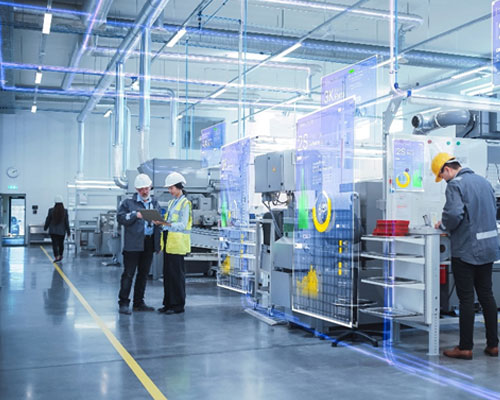
Rising production costs, workforce shortages, volatile supply chains, and ever-increasing pressure to deliver at speed. MicroAI’s manufacturing-specific Agentic AI & GenAI solutions are built to help modern factories overcome these challenges by enabling autonomous decision-making, predictive problem-solving, and end-to-end operational optimization.
Higher Equipment Uptime – downtime reduced by 20-30%
Scrap Reduction and Improved Yield – scrap reduced by 15-25%
Cycle-Time Reduction – cycle-times reduced by 10-20%
Reduced Energy Consumption – 5-20% reduction in energy use
Reduced Cost – 7-20% reduction in CoS
Migwelder Digital Twin
Mig Welder asset owners and operators experience sub-par welder performance due to lack of deep, predictive, observability into welder performance and health.
MicroAI’s Agentic AI goes beyond traditional automation. It uses specialized, autonomous AI agents that can:
Provide 360° observation of machine and machine group data
Analyze performance, detect faults, and forecast issues
Propose and execute decisions within defined guardrails
Collaborate with humans and other Agents to optimize workflows
Combined with Generative AI, these agents create actionable insights, generate instructions or documentation, and adapt dynamically to changing variables in real time.
Core Capabilities
Autonomous Production Optimization
Edge-based analysis of machine health, cycle times, and line and shift consistency
Independent adjustment of operating parameters to optimize output
GenAI-enabled insights into historical issues and impactful resolutions
Intelligent Quality Verification
Multi-agent collaboration (vision and sensor) for instant defect detection and automated alerts
GenAI-enabled corrective action insights and query-based quality trend forecasting
Closed-loop, human-in-the-loop, correctitve action implementation, validation, and audit trails
Predictive and Autonomous Machine Maintenance
Embedded, edge-based, machine-learning models learn the normal state of machine behavior and trigger alerts on impending failure
Agentic AI triggers proactive work orders, inspections, or component replacements
Extends asset lifespans, reduces downtime, optimizes energy consumption, and lowers emergency repair costs
Supply Chain and Inventory Intelligence
Combination of operational data and external signals (demand forecasts, supplier performance analytics, logistics updates) to maintain opitimal inventory levels
Predict material shortages
Insight-fueled order scheduling
Proactive alternative sourcing
Workforce Augmentation
AI agents act as autonomous assistants that handle routine, repetitive, and time-consuming tasks so human teams can focus on higher-value work
GenAI provides contextual recommendations by pulling from manuals, historical data, tribal knowledge, and real-time telemetry
GenAI captures institutional knowledge that usually disappears with retirements or turnover
Example Use Cases and Impacts
Predictive Maintenance
Edge Agents review sensor data and historical failures, trigger diagnostics, and autonomously schedule maintenance.
Impact: Reduces unplanned downtime and replacement costs
Optimizing Production Scheduling
Agentic systems simulate, optimize, and re-plan schedules based on real-time shop-floor constraints (machine downtime, material availability, WIP levels).
Impact: Higher OEE, fewer bottlenecks, smoother workflows
Yield Optimization and Parameter Tuning
AI Agents run multi-variate optimization to find ideal process conditions for extrusion, molding, welding, machining, and heat treatment.
Impact: Higher first-pass yield, reduced scrap, lower cost
Energy Management and Sustainability Automation
Agentic AI autonomously adjusts energy-intensive systems (HVAC, ovens, compressors) to minimize consumption without impacting throughput.
Impact: Lower energy cost, improved sustainability KPIs, reduced carbon footprint
How it Works
Step 1 – Connect and Collect
Integrates with MES, ERP, SCADA, PLCs, sensors, and machine systems
Step 2 – Analyze and Predict
Edge-based AI agents interpret historical and real-time data to find patterns and forecast outcomes
Step 3 – Recommend and Act
Depending on customized governance rules, the system delivers:
Autonomous actions for optimization
Human-in-the-loop recommendations
Continuous, closed-loop, optimization and verification cycles
Step 4 – Learn and Improve
AI Agents evolve with every interaction, ensuring long-term reliability and adaptability