Maintenance Managers
Focus inspections and maintenance resources on equipment that needs attention. Balance developing risks against production schedules and available maintenance windows.


An unexpected equipment failure affects more than one machine. It can interrupt production schedules, increase overtime, delay shipments, and put pressure on the entire plant.
Predictive maintenance software helps teams recognize developing equipment problems and make better-informed maintenance decisions. Instead of relying entirely on fixed service intervals or reacting to breakdowns, teams can use machine condition and performance trends to guide their response.
MicroAI brings machine data into that decision-making process, helping your team focus attention where it matters most.
Bring machine signals and operating history together to understand changing asset condition.
Identify unusual behavior that warrants investigation before it becomes a larger operational problem.
Use equipment condition and developing risk to help decide what needs attention first.
Connect performance changes with machine history and operating context to support troubleshooting.
Ask equipment questions in plain language and explore contextual answers with your team.
Use machine insights to guide improvements in availability, overall equipment effectiveness, and production consistency.
Bring together available machine signals, process information, maintenance history, and operating context.
Establish a machine-specific understanding of performance under actual operating conditions.
Detect changes that may indicate deterioration, abnormal operation, or increasing maintenance risk.
Use the findings to guide inspection, troubleshooting, and maintenance planning. Validate recommended actions against your equipment procedures and operating requirements.
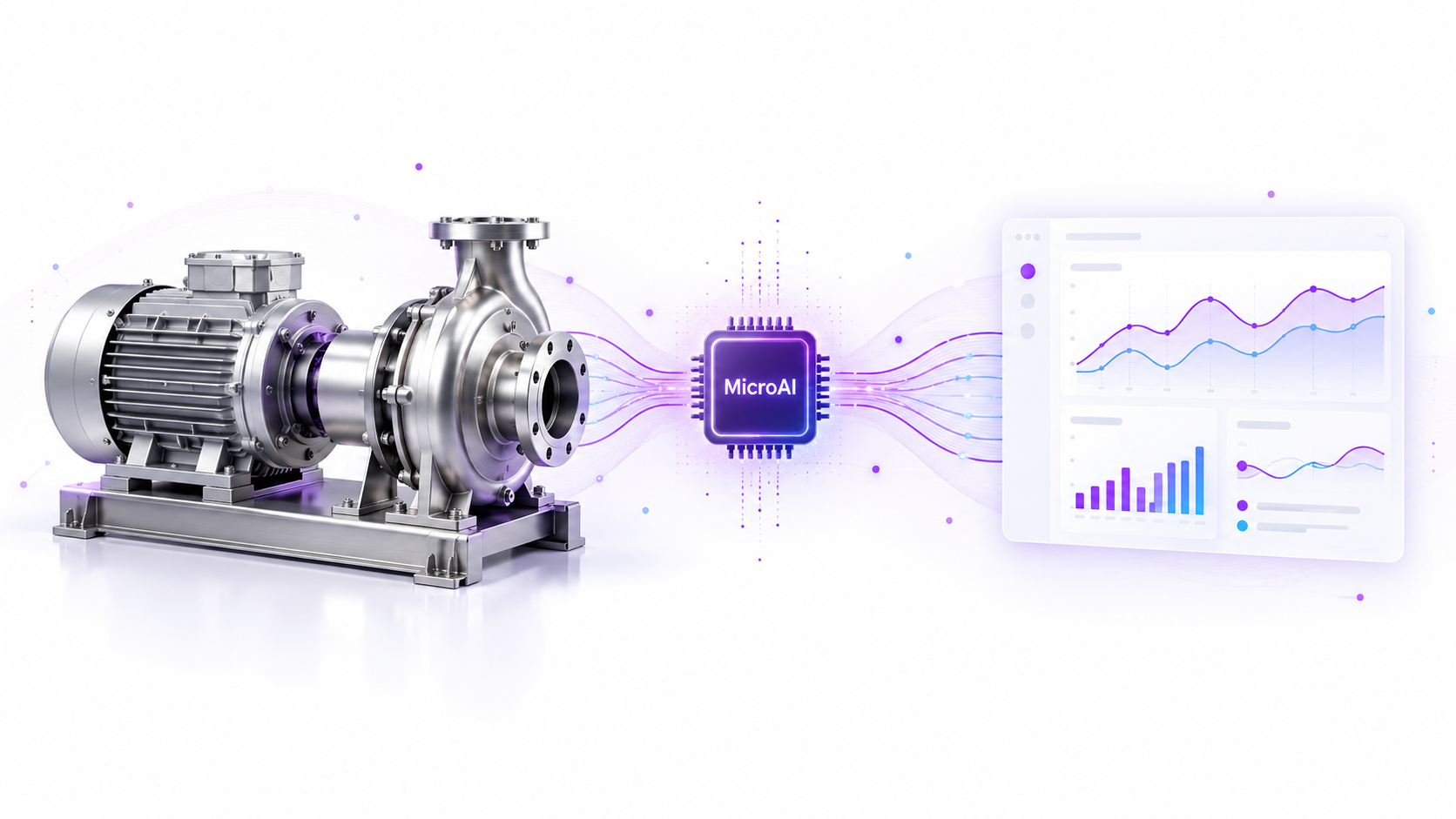
MicroAI processes critical information on or near industrial equipment. Its machine-specific approach considers operating conditions and historical behavior to support relevant analysis while reducing reliance on continuous cloud data transfer.
Focus inspections and maintenance resources on equipment that needs attention. Balance developing risks against production schedules and available maintenance windows.
Evaluate changing equipment behavior, investigate recurring problems, and assess whether maintenance interventions address the underlying issue.
Connect equipment reliability with production priorities. Give maintenance and production teams a shared basis for discussing risk, planned interventions, and operational impact.
A useful evaluation begins with a specific equipment problem and a measurable objective.
Choose an asset or production area where unexpected downtime, recurring faults, or excessive maintenance creates a clear operational cost. Review the available data and define what a successful outcome would look like.
Which equipment and failure modes should be evaluated first?
What machine signals and maintenance records are available?
What additional data, if any, is needed?
How will findings reach the people responsible for taking action?
Which deployment and integration requirements apply?
How will the team measure operational value?
Predictive maintenance software analyzes equipment condition and operating data to identify developing problems and help anticipate maintenance needs. It supports decisions about when to inspect or service equipment before a potential failure interrupts operations.
Preventive maintenance typically follows scheduled intervals, such as operating hours or calendar dates. Predictive maintenance uses equipment data and analysis to guide maintenance timing. Many plants use both approaches, depending on asset criticality, available data, and required service procedures.
Condition monitoring tracks equipment health and changes in operating behavior. Predictive maintenance uses condition data and analysis to help anticipate future maintenance needs. An anomaly is a reason to investigate; it does not automatically establish a specific failure or failure date.
Relevant data may include vibration, temperature, pressure, electrical measurements, operating loads, and maintenance records. The requirements depend on the equipment and the problem being investigated. Data quality, sampling frequency, and coverage of normal operating conditions affect what the analysis can reveal.
That depends on the data your equipment already provides. Existing signals may support the selected use case, while some failure modes require additional measurements. Review data availability before deciding whether new sensors are necessary.
The timeline depends on equipment access, data readiness, deployment requirements, integration work, and evaluation scope. Begin with a clearly defined use case so the team can establish realistic milestones and success criteria.